ChatGPT vs Claude – Honest Comparison for Beginners
ChatGPT hit 100 million users in two months after launch. That is faster than any consumer app in history – faster than Instagram, faster than TikTok. Claude arrived four months later, quieter and less famous. By April 2026, Anthropic’s revenue had grown from $1 billion to $30 billion in fifteen months. Axios searched for a comparable growth rate across every industry in every era. They could not find one.
These are not two versions of the same product. They are two different tools built on two different philosophies. If you are new to AI and trying to figure out which one to use, this is the guide you actually needed. No affiliate links. No brand favoritism. Just data, benchmarks, and real use cases.
ChatGPT hit 100 million users in two months after launch. That is faster than any consumer app in history faster than Instagram, faster than TikTok. Claude arrived four months later, quieter and less famous. By April 2026, Anthropic’s revenue had grown from $1 billion to $30 billion in fifteen months. Axios searched for a comparable growth rate across every industry in every era. They could not find one.
These are not two versions of the same product. They are two different tools built on two different philosophies. If you are new to AI and trying to figure out which one to use, this is the guide you actually needed. No affiliate links. No brand favoritism. Just data, benchmarks, and real use cases.
What Are ChatGPT and Claude?
ChatGPT is built by OpenAI and runs on GPT-5.4. It is the Swiss Army knife of AI. It generates images through DALL-E, browses the internet in real time, processes voice, runs code in a built-in sandbox, and connects with thousands of third-party tools through its GPT marketplace. Over 200 million people use it every week. When most people say “I use AI,” they mean ChatGPT.
Claude is built by Anthropic – a company founded by former OpenAI researchers who believed the industry was not taking safety seriously enough. It runs on Claude Sonnet 4.6 and Opus 4.6. It cannot generate images. It does not browse the web by default. What it does instead is handle long, complex, precise tasks at a level of consistency that most users notice within the first week. Claude holds 54% of the enterprise coding market. Claude Code – Anthropic’s terminal tool has become standard in professional engineering teams worldwide.
Two different bets on what AI should be.
Real Task Comparison
Does Writing Quality Actually Differ?
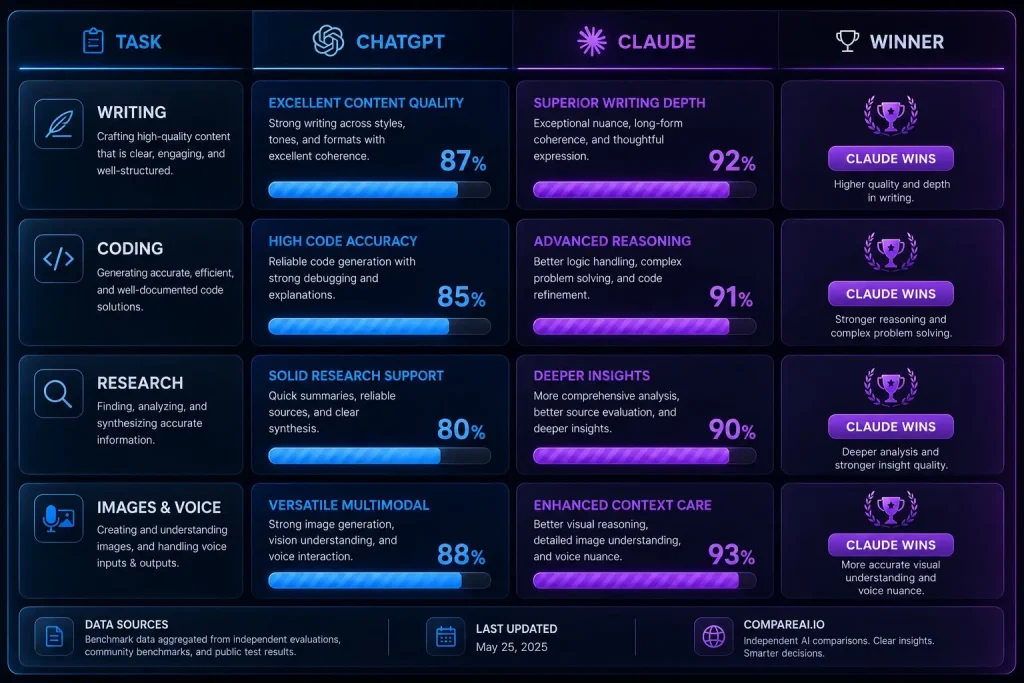
Yes. And the gap is noticeable. For quick tasks emails, short posts, rough drafts – both tools work fine. The difference becomes obvious when the task gets harder.
Claude produces writing that varies sentence length naturally, avoids corporate buzzwords, and matches tone more accurately. The consensus among professional writers who have tested both tools: Claude reads more human-like, while ChatGPT produces output that is competent but recognizable as AI.
For creative brainstorming – 20 quirky newsletter ideas, a funny tweet thread, rapid fire concepts – ChatGPT is faster, more playful, and less neutral. Claude’s brainstorming tends to be more considered and, honestly, a bit more conservative by default.
For content that needs to convert readers, not just inform them, Claude wins. For fast creative output in bulk, ChatGPT wins.
Coding – Is There Actually a Difference?
Why? Because the data is unusually clear here.
Claude Opus 4.6 scores 80.8% on SWE-bench Verified, the industry standard benchmark for real-world software engineering. Claude Sonnet 4.6 scores 79.6%. GPT-5.4 scores approximately 80%. The overall gap at the top is narrow. But independent testing by Ryz Labs found Claude achieves 95% functional coding accuracy versus ChatGPT’s 85% – a 10-point margin that directly means fewer bugs, fewer debugging sessions, and fewer review cycles per project.
Three specific advantages explain why 70% of developers prefer Claude for coding in 2026 surveys. First, multi-file codebase handling – Claude tracks dependencies and imports across files more reliably. Second, refactoring accuracy – Claude preserves behavioral correctness when restructuring existing code. Third, Claude produces far fewer hallucinated API calls, it does not invent function signatures that do not exist. ChatGPT occasionally does. For anyone who has spent an hour chasing a phantom bug, that distinction matters.
If you write code, Claude is the clearer choice.
Research and Long Documents – Which One Loses the Thread?
Claude’s context window holds 200,000 tokens by default, with 1 million available on Opus 4.6. It shows less than 5% accuracy degradation across the full context range. GPT-5.4 shows measurable degradation for information positioned in the middle of a long document.
Upload a 300-page PDF to Claude and ask it to find three contradictions, summarize chapter five, and pull the key decision points. It handles the full task without losing coherence. ChatGPT with the same document starts to drift after a certain point earlier in the document, later in the conversation, the thread weakens.
For students, researchers, lawyers, and anyone working with large volumes of text, Claude wins clearly.
Images and Voice – No Contest
ChatGPT wins this category without argument.
Claude cannot generate images. Claude has no native audio capability. ChatGPT generates images through DALL-E built directly into the interface. It processes voice natively. It interprets charts, tables, and diagrams with its vision features. If image generation or voice conversation is part of your workflow at all, you need ChatGPT.
Which One Costs More?
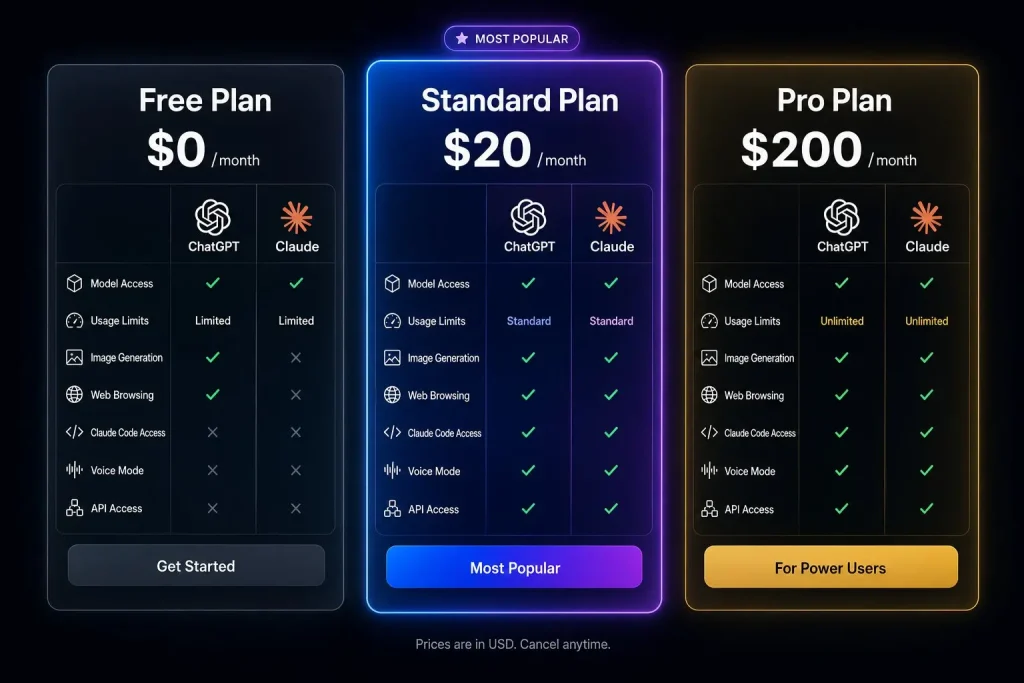
Claude Pro includes Claude Code – a terminal coding agent at no extra cost. ChatGPT Plus includes DALL-E image generation and web browsing. At the top tier, Claude Max costs $100 or $200 per month. ChatGPT Pro costs $200 per month.
At the API level for developers, GPT-5-mini costs $0.25 per million input tokens. Claude Haiku 4.5 costs $1.00 per million input tokens four times more expensive, but scores higher on complex tasks. The cost per correct answer depends entirely on what you are asking.
For most beginners, the $20 decision comes down entirely to what you need — not what you pay.
Pricing Breakdown
| Plan | ChatGPT | Claude |
|---|---|---|
| Free | GPT-4o with daily limits | Sonnet 4.6 with message limits |
| Standard ($20/mo) | DALL-E + web browsing | Claude Code terminal included |
| Pro/Max | $200/month | $100 or $200/month |
| API (cheapest) | GPT-5-mini at $0.25/1M tokens | Haiku 4.5 at $1.00/1M tokens |
Myths Most Beginners Believe
Myth 1: ChatGPT is smarter.
The Chatbot Arena rankings put Claude Opus 4.6 and GPT-5.2 in a statistical dead heat for general tasks. In a seven-round bracket-style competition published by Tom’s Guide in May 2026, Claude defeated ChatGPT in the final to win the “2026 AI Madness” championship. The judges cited Claude’s ability to hold contradictory ideas without collapsing them into generic answers. Neither tool is smarter overall. They are smarter at different things.
Myth 2: Claude is safer so it refuses more.
Both tools have guardrails. Anthropic uses Constitutional AI – ethical principles built into training at a deep level, not surface filters applied after the fact. In practice, for everyday tasks, you will not notice a meaningful difference in how often either tool declines a request. The safety distinction matters most in regulated industries like healthcare or finance, where compliance officers review AI outputs.
Myth 3: The free version is good enough.
For very light use, yes. For writing, coding, or document work – both free versions hit usage limits quickly and restrict access to the strongest models. If you use AI for work more than a few times per week, the $20 plan on either tool pays for itself in time saved. The free tier is a trial, not a long term option.
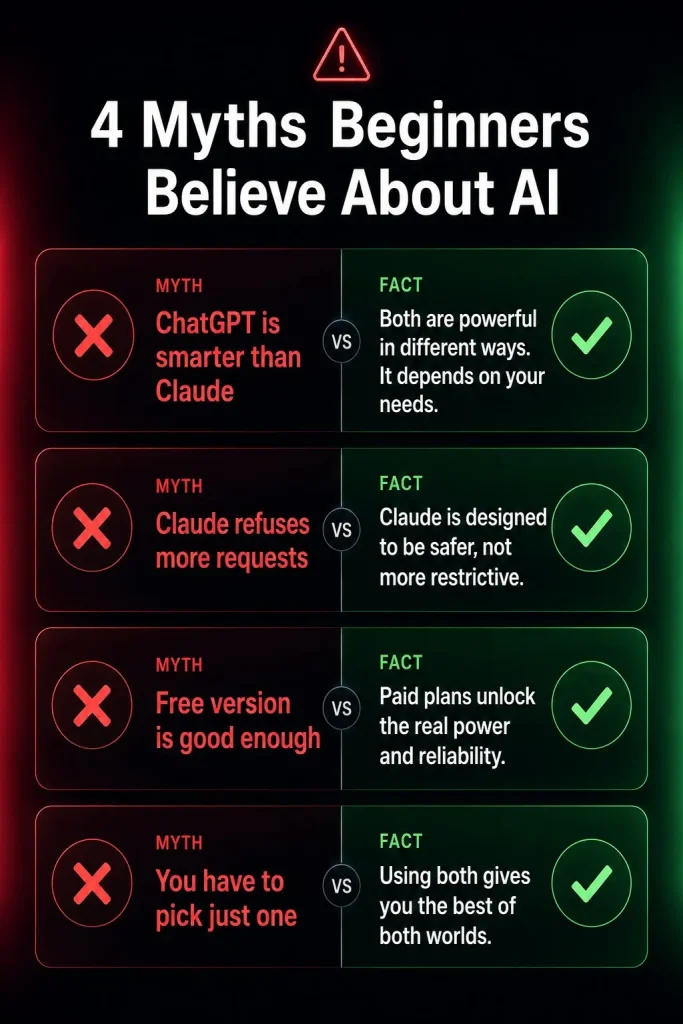
Myth 4: You have to pick one.
The smartest users in 2026 use both. ChatGPT to explore and brainstorm. Claude to refine and execute. The friction of switching between them is minimal, and the quality improvement on the right task is real.
Who Should Use Which One?
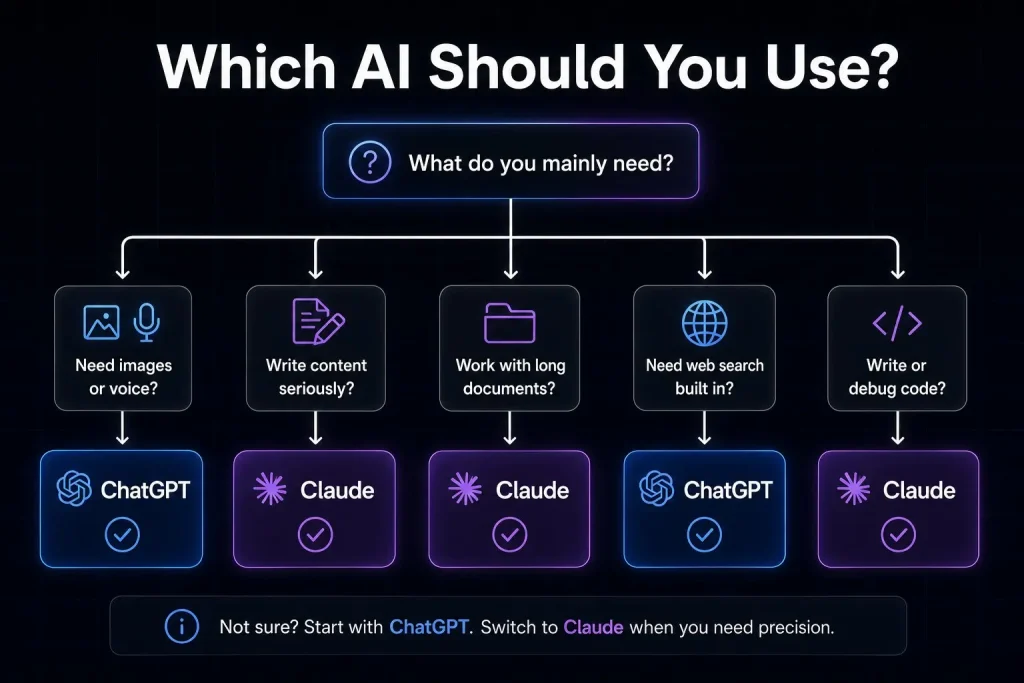
Start with ChatGPT if you want one tool that handles everything in one place – images, voice, web browsing, code execution, and access to thousands of specialized GPTs. ChatGPT is more forgiving with vague prompts. It makes reasonable assumptions and produces useful output even when instructions are incomplete. It is the better starting point if you are not sure what you need yet.
Open ChatGPT today if:
- You want one tool that handles everything – images, voice, web search, code execution
- You are not sure exactly what you need yet and want something forgiving with vague prompts
- You work inside the Microsoft 365 ecosystem
- Image generation is a core part of your work
Start with Claude if you write seriously, work with long documents, or want to learn coding. Claude asks more clarifying questions before answering, which feels slower at first and turns out to be more accurate more often. Prof. Dr. Kay Rottmann, Professor of Applied AI at HdM Stuttgart and former Senior Applied Scientist at Amazon Alexa, frames it directly: “GPT-5 for most end users, Claude for developers and application builders.”
Open Claude today if:
- You write seriously and need output that sounds human
- You work with long documents – contracts, research papers, books
- You want to learn coding or improve code quality
- You need an AI that follows complex, multi-step instructions precisely
Most people discover a clear preference within one week of using both. That preference almost always tracks with this breakdown. ChatGPT for breadth and versatility. Claude for depth and precision.
The tools are converging. The gap between them is smaller than the gap between either one and everything else available. Whichever you choose, you are using a genuinely powerful tool. The only wrong move is picking one based on which name you heard first.
Final Verdict
Most people spend more time picking an AI than actually using one. That is the real problem.
Here is the truth nobody says out loud. Both ChatGPT and Claude are exceptional tools. Both will make you faster, smarter, and more productive within the first week. The difference between them is not capability – it is fit. A hammer is not better than a screwdriver. They just do different things.
If you take nothing else from this guide, take this. Use ChatGPT when you need breadth – images, voice, web search, quick output, versatility. Use Claude when you need depth – writing that sounds human, code that does not hallucinate, documents that do not break context halfway through.
The people who get the most out of AI in 2026 are not the ones who picked the right tool. They are the ones who stopped debating and started using.
Pick one today. Open it. Give it your actual work. You will have your answer within an hour – and no comparison article, including this one, would have told you faster.
FAQ
Is Claude better than ChatGPT for beginners?
Neither is universally better for beginners. ChatGPT is easier to start with – it does more in one place and handles vague prompts without asking clarifying questions. Claude produces better writing and coding output but requires more precise instructions. Start with ChatGPT if you are unsure. Move to Claude when your tasks require accuracy over speed.
Can I use both ChatGPT and Claude for free?
Yes. Both have free tiers with usage limits. ChatGPT’s free version gives access to GPT-4o with daily restrictions. Claude’s free version gives access to Claude Sonnet 4.6 with approximately 25 to 40 messages per day. Both free tiers are enough to test the tools before committing to a paid plan.
Which is better for students?
Claude. Its ability to process long documents without losing context makes it significantly better for research, summarizing academic papers, and working through complex material. Users who switched from ChatGPT to Claude for study work consistently describe it as the difference between a general assistant and an actual thinking partner.
Does Claude generate images?
No. Claude has no image generation capability at all. If images are part of your workflow, use ChatGPT- DALL-E is built directly into the interface with no extra steps.
Which AI makes fewer factual mistakes?
Claude Opus 4.6 scores 91.3% on GPQA Diamond PhD-level science questions – the widest margin over any competing model on any major benchmark in 2026. Claude also hallucinates API calls less frequently in coding tasks. For factual accuracy in high-stakes domains, Claude currently leads.
Is the $20 per month plan worth it?
Yes, for regular users. Both plans unlock frontier models, higher usage limits, and features unavailable on free tiers. Claude Pro includes Claude Code. ChatGPT Plus includes DALL-E and web browsing. If you use AI more than a few times per week for real work, the free tier will limit you before long.
Which should I pick if I can only afford one?
If writing, coding, or document analysis is your primary use – Claude. If you need images, voice conversation, or real-time web search as core features – ChatGPT. If you are genuinely unsure, start with ChatGPT because it covers more use cases in one place.
Pick the tool that matches your actual work. Use both when you can. The AI that improves your output by 30% is better than the AI you chose because it had more Twitter followers.